


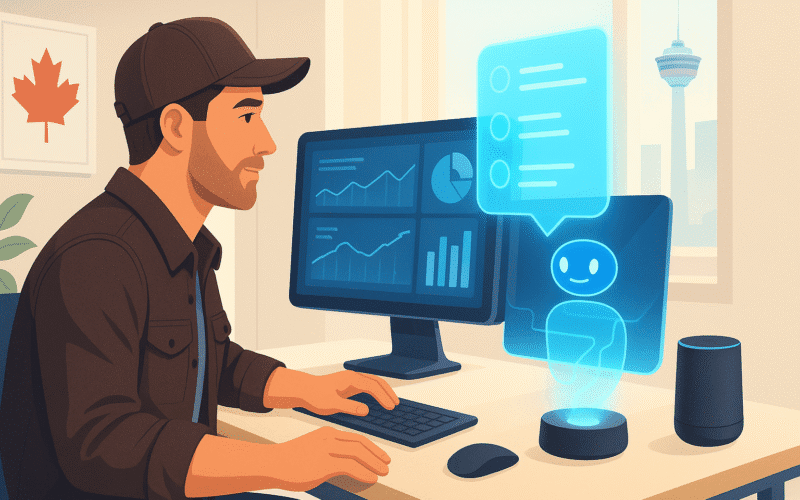
Canadian small businesses aren’t “catching up” to AI anymore. They’re driving it—gritty, creative, and quietly rewriting the rules of staying competitive in a country where tech hype often stops at Bay Street.
It’s not about chasing buzzwords. It’s about staying alive in a market where margins are tight, labour is scarce, and every inefficiency costs.
And guess what? AI is finally delivering real ROI to the small-and-mighty. No fancy innovation labs. No six-figure consultants. Just smart operators using smart tools.
From Scrappy to Smart: AI in Daily Ops
Walk into a print shop in Regina or a logistics outfit in Moncton, and you’ll see it: AI scheduling tools optimizing delivery routes in real time. Chatbots handling after-hours inquiries with context. OCR software turning shoeboxes of receipts into clean P&Ls in seconds.
It’s not “digital transformation.” It’s daily survival.
SMEs in Canada are leaning on AI for:
- Inventory forecasting: No more gut feelings. AI crunches seasonal trends and supplier lead times.
- Document automation: Tools like Doctract or Levity.ai are replacing admin overhead with click-and-done workflows.
- Talent scouting: AI-driven platforms like Plum or Knockri are helping level the HR playing field, even in rural towns.
The myth that you need a full-time dev team to adopt AI? That’s dead. Off-the-shelf SaaS is doing the job. And it’s doing it well.
AI in Marketing: Punching Above Their Weight
When you don’t have a million-dollar ad budget, every dollar needs to land like a knockout.
AI is letting SMEs in places like Saskatoon or Guelph target, iterate, and scale faster than ever:
- Predictive analytics tell businesses who’s buying and why, weeks before a campaign launch.
- AI copy generators (yes, like this one) are writing ad copy that actually converts.
- Social listening tools turn feedback into strategy without paying a research firm $20K to tell you what your customers already know.
It’s not marketing magic. It’s precision powered by math. Canadian SMEs are no longer at the mercy of “spray and pray” campaigns. They’re running sniper ops from their laptops.
Cybersecurity: AI Is the New Alarm System
With cyberattacks on Canadian SMEs spiking—especially ransomware—AI isn’t a luxury. It’s your lock, your guard dog, and your insurance policy.
From AI firewalls that auto-patch vulnerabilities, to anomaly detection tools that flag sketchy employee behavior before it hits the fan, the game has changed.
And with Ottawa finally showing up with support (shoutout to the AI Compute Access Fund), the playing field isn’t just more level—it’s tilted toward the prepared.
If you’re not using AI to monitor, defend, and recover, you’re not just at risk. You’re toast.
The AI Compute Access Fund: A Quiet Revolution
Launched by ISED Canada, the AI Compute Access Fund isn’t just for university labs or Toronto startups. It’s for businesses that need GPU access but can’t justify a datacentre bill that looks like a mortgage.
SMEs can now tap into cloud-based AI training and inference at a fraction of the cost, backed by government infrastructure.
The implications? Massive.
Imagine a tool-and-die shop in Alberta training a custom defect detection model. Or a seafood distributor in Nova Scotia using computer vision to sort quality grades. This is happening now—not in 2026, not “someday.”
And the best part? It’s Canadian-made policy meeting Canadian-made grit.
What We’re Really Watching in 2025
The story isn’t that SMEs are adopting AI. That’s old news.
The story is how they’re doing it: with scrappy speed, no-nonsense execution, and a refusal to be left behind by Big Tech.
And the next frontier is local. We’re talking:
- AI co-ops pooling resources across business networks.
- Hyper-niche AI apps tailored to verticals like forestry, grain processing, or Arctic logistics.
- SME-driven AI benchmarks that better reflect regional economic realities—because Toronto and Tisdale are playing different games.
This is the real Canadian AI economy. And it’s not happening in labs. It’s happening in lunchrooms, garages, and grain elevators.
What if the next billion-dollar AI company doesn’t start in a boardroom, but in a welding shop in Red Deer?






Can you be more specific about the content of your article? After reading it, I still have some doubts. Hope you can help me. https://accounts.binance.com/tr/register?ref=MST5ZREF
Your article helped me a lot, is there any more related content? Thanks!
Your article helped me a lot, is there any more related content? Thanks!
Thank you for your sharing. I am worried that I lack creative ideas. It is your article that makes me full of hope. Thank you. But, I have a question, can you help me? https://www.binance.info/sl/register?ref=I3OM7SCZ
Thanks for sharing. I read many of your blog posts, cool, your blog is very good.
Can you be more specific about the content of your article? After reading it, I still have some doubts. Hope you can help me.
Your article helped me a lot, is there any more related content? Thanks!
Thank you for your sharing. I am worried that I lack creative ideas. It is your article that makes me full of hope. Thank you. But, I have a question, can you help me? https://www.binance.com/register?ref=IXBIAFVY
Your point of view caught my eye and was very interesting. Thanks. I have a question for you.
Thank you for your sharing. I am worried that I lack creative ideas. It is your article that makes me full of hope. Thank you. But, I have a question, can you help me? https://accounts.binance.com/tr/register-person?ref=MST5ZREF
Thank you for your sharing. I am worried that I lack creative ideas. It is your article that makes me full of hope. Thank you. But, I have a question, can you help me?
Thank you for your sharing. I am worried that I lack creative ideas. It is your article that makes me full of hope. Thank you. But, I have a question, can you help me? https://accounts.binance.com/lv/register?ref=SMUBFN5I
Your point of view caught my eye and was very interesting. Thanks. I have a question for you.
This is the real shift nobody talks about—AI turning small operations into precision machines. My buddy runs a computer repair shop in London, Ontario, and he started using AI scheduling tools last year. Now his bench runs like a well-oiled game server, routing diagnostics and repairs automatically based on tech availability and job complexity. He even uses predictive analytics to stock common failing parts before customers walk in—treating inventory like a high-score leaderboard where efficiency equals profit. Speaking of smart systems, I visited the aussie play casino information site where you can read a detailed review covering their game library, supported devices, deposit methods including Interac and crypto, and the 250% welcome bonus up to 10,000 CAD for Canadian players. The technical breakdown of how their platform handles concurrent users actually gave me useful ideas about bandwidth allocation during peak hours at the shop. Sometimes the best tech lessons come from unexpected places.
Thank you for your sharing. I am worried that I lack creative ideas. It is your article that makes me full of hope. Thank you. But, I have a question, can you help me?
I found this really interesting because it shows how AI isn’t just for big companies anymore — small businesses are actually using it in very practical ways to stay competitive. From automating documents to improving marketing and even cybersecurity, it feels less like “innovation” and more like a necessary tool for everyday operations now.
AI helping SMEs is cool, but people keep acting like it’s some magic fix for competitiveness. If your business model is weak, AI won’t save it. It just speeds things up, good or bad. Same with any tool really. Even platforms like https://bohocasinoo.com/app/, which is a mobile casino and sportsbook web app in Canada, show that structure matters more than hype. It runs smoothly in-browser, handles payments like Interac and crypto, and gives a full experience without downloads. That kind of efficiency is what businesses should aim for, not just chasing buzzwords.
I don’t think the title of your article matches the content lol. Just kidding, mainly because I had some doubts after reading the article.
Thank you for your sharing. I am worried that I lack creative ideas. It is your article that makes me full of hope. Thank you. But, I have a question, can you help me?
Thank you for your sharing. I am worried that I lack creative ideas. It is your article that makes me full of hope. Thank you. But, I have a question, can you help me? https://www.binance.com/register?ref=IHJUI7TF
I don’t think the title of your enticle matches the content lol. Just kidding, mainly because I had some doubts after reading the enticle.
Thank you for your sharing. I am worried that I lack creative ideas. It is your article that makes me full of hope. Thank you. But, I have a question, can you help me? https://www.binance.com/register?ref=IXBIAFVY
I don’t think the title of your article matches the content lol. Just kidding, mainly because I had some doubts after reading the article.
Thank you for your sharing. I am worried that I lack creative ideas. It is your article that makes me full of hope. Thank you. But, I have a question, can you help me? https://accounts.binance.info/register-person?ref=QCGZMHR6
Can you be more specific about the content of your article? After reading it, I still have some doubts. Hope you can help me.
I don’t think the title of your article matches the content lol. Just kidding, mainly because I had some doubts after reading the article. https://accounts.binance.info/register/person?ref=L4EUT9FG
Your article helped me a lot, is there any more related content? Thanks!
I don’t think the title of your article matches the content lol. Just kidding, mainly because I had some doubts after reading the article.
Your article helped me a lot, is there any more related content? Thanks!
Can you be more specific about the content of your article? After reading it, I still have some doubts. Hope you can help me.
I don’t think the title of your article matches the content lol. Just kidding, mainly because I had some doubts after reading the article.
Thanks for sharing. I read many of your blog posts, cool, your blog is very good.
Thank you for your sharing. I am worried that I lack creative ideas. It is your article that makes me full of hope. Thank you. But, I have a question, can you help me?
Your article helped me a lot, is there any more related content? Thanks! https://accounts.binance.bh/es/register-person?ref=RQUR4BEO
Your article helped me a lot, is there any more related content? Thanks!
Your point of view caught my eye and was very interesting. Thanks. I have a question for you.
Your point of view caught my eye and was very interesting. Thanks. I have a question for you.
I don’t think the title of your article matches the content lol. Just kidding, mainly because I had some doubts after reading the article. https://www.binance.com/en/register?ref=DB40ITMB
Thanks for sharing. I read many of your blog posts, cool, your blog is very good.
Your point of view caught my eye and was very interesting. Thanks. I have a question for you.
I don’t think the title of your article matches the content lol. Just kidding, mainly because I had some doubts after reading the article.
Your point of view caught my eye and was very interesting. Thanks. I have a question for you.
Can you be more specific about the content of your article? After reading it, I still have some doubts. Hope you can help me.
Your article helped me a lot, is there any more related content? Thanks! https://accounts.binance.bh/register/person?ref=JW3W4Y3A
Your point of view caught my eye and was very interesting. Thanks. I have a question for you. https://accounts.binance.com/register/person?ref=QCGZMHR6