



AI fluency is the pillar I see teams overrate most. Plenty of teams own AI tools. Far fewer use them every week to save time on real work.
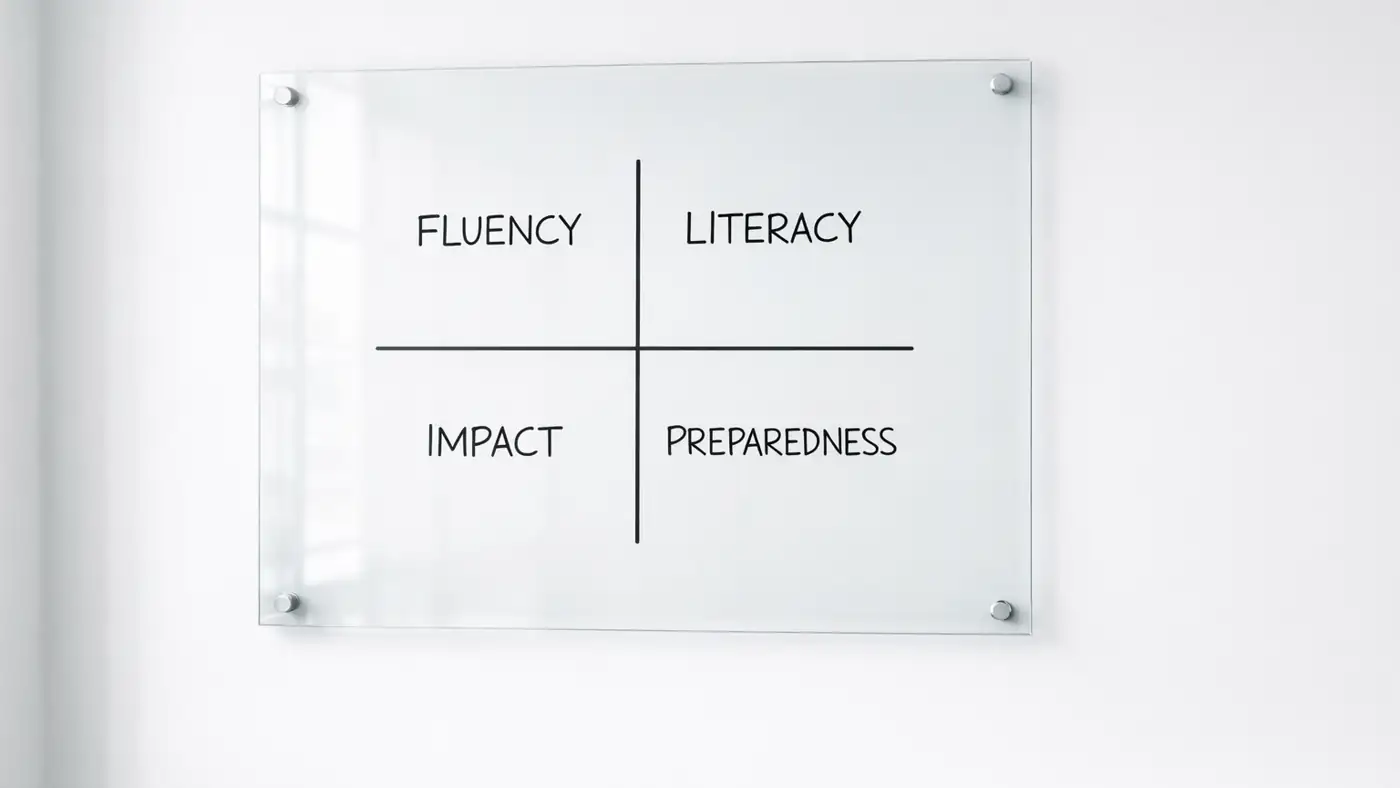
A login is easy. A habit takes practice. Fluency is the F in FLIP, and it is where I start.
Key points
I’m ZAK, founder of ORKA AI. In November I introduced FLIP, an AI readiness framework built for Canadian leaders. This is the first pillar up close. We start with Fluency because nothing else in FLIP moves until people actually use the tools.
What is AI fluency?
AI fluency is your team’s practical ability to use AI tools to do meaningful work. A fluent team uses an approved tool weekly on real tasks, gives it clear context and examples, checks the output before it reaches a customer, and shares what works. Curiosity alone is not fluency. Weekly results are.
The test is boring and that’s why it works. Ask five people what they used AI for last week. If you get blank looks, or one person answers for everyone, your fluency score is low, whatever your licence count says.
How do you measure AI fluency on your team?
Use the five Fluency statements from the FLIP scorecard and rate each from 1 to 5. Look for weekly use on real work, good briefing, output checks, repeatable workflows and shared prompts. If you cannot name a person or a file as proof, the honest score is 1 or 2.
Notice what isn’t on the list. Tool count. Spend. Number of pilots. Those are inputs. Fluency is about what people do on a Tuesday afternoon.
Why does prompt skill matter for AI fluency?
Because the same tool gives a weak answer to a weak brief. People who give context, an example and a clear format get usable drafts. People who type one vague line give up. Teaching briefing is the cheapest fluency win most teams can get.
Even Ottawa treats this as a core skill. The federal Guide on the use of generative AI includes being “Educated” in its FASTER principles, which covers learning how to create effective prompts and spot weak output. If public servants are told to build the skill, your team can too.
Want a concrete exercise? Take a real task like the one in our walkthrough on writing a business proposal with Perplexity AI and have three people brief the same tool differently. Compare. The lesson lands in ten minutes.
How can a team build AI fluency in two weeks?
Pick one team and one real task that repeats every week. For two weeks, everyone does that task with AI, writes down what worked and checks every output. Hold a short weekly show-and-tell. At the end, save the best prompt as a shared template.
Here’s my playbook:
- Choose a dull, frequent task. Meeting notes, first-draft replies, weekly summaries. Our test of Gmail’s free AI summaries is a good example of starting small.
- Set a baseline. How long does it take today?
- Run it for ten working days. Everyone, every time.
- Do a twenty-minute show-and-tell each Friday. Wins and fails both count.
- Save the winners. One shared doc of prompts people actually reuse.
Then rescore Fluency. The point of the sprint is habit: AI use becomes normal on one task, and that is far easier to spread than a licence rollout.
What goes wrong when AI fluency outruns everything else?
Speed without judgment. A fluent team that lacks Literacy pastes client data into public tools and trusts confident wrong answers. That is why FLIP pairs Fluency with Literacy. Build the habit first, then build the judgment right behind it, ideally within the same quarter.
Your move this week: grab the free FLIP scorecard, score the Fluency pillar with your team, and pick your sprint task. Two weeks from now, you’ll have a real answer instead of a licence count.
Who on your team should lead AI fluency?
The person who already owns the task. Technical skill matters less than you think. AI fluency sticks when the payroll lead improves payroll and the sales lead improves follow-ups. Give each team one fluency champion who runs the weekly show-and-tell and keeps the shared prompt library tidy.
Leaders matter here too. When an owner shares their own prompt in a team meeting, the room relaxes. People stop worrying that using AI looks like cutting corners. Model the behaviour you want, then make it easy to copy. That’s how AI fluency moves from a few keen people to the whole team.
This won’t fix a bad process. If the task itself is broken, AI just runs the broken version faster. Clean up the steps first, then sprint.
Frequently asked questions
What is AI fluency?
AI fluency is the practical ability to use AI tools for real work every week: briefing them well, checking the output and sharing workflows that work. It is the first pillar of the FLIP framework.
Is AI fluency the same as AI literacy?
No. Fluency is skill, the ability to get useful work done with AI. Literacy is judgment, knowing where AI is wrong and what data stays out. FLIP scores them separately.
How fast can a team improve AI fluency?
A focused two-week sprint on one real, repeating task usually lifts use quickly, because it turns AI into a habit rather than an experiment.
How do I score AI fluency?
Rate the five Fluency statements in the free FLIP scorecard from 1 to 5, then add them for a score out of 25.
Disclosure: ZAK is the founder of ORKA AI; aiwithzak.com is his website. This column describes his own framework. It is analysis and opinion.