



Most AI readiness checklists grade your software. I think that is backwards. An AI readiness framework should tell a leadership team how ready its people are first, so I built FLIP.
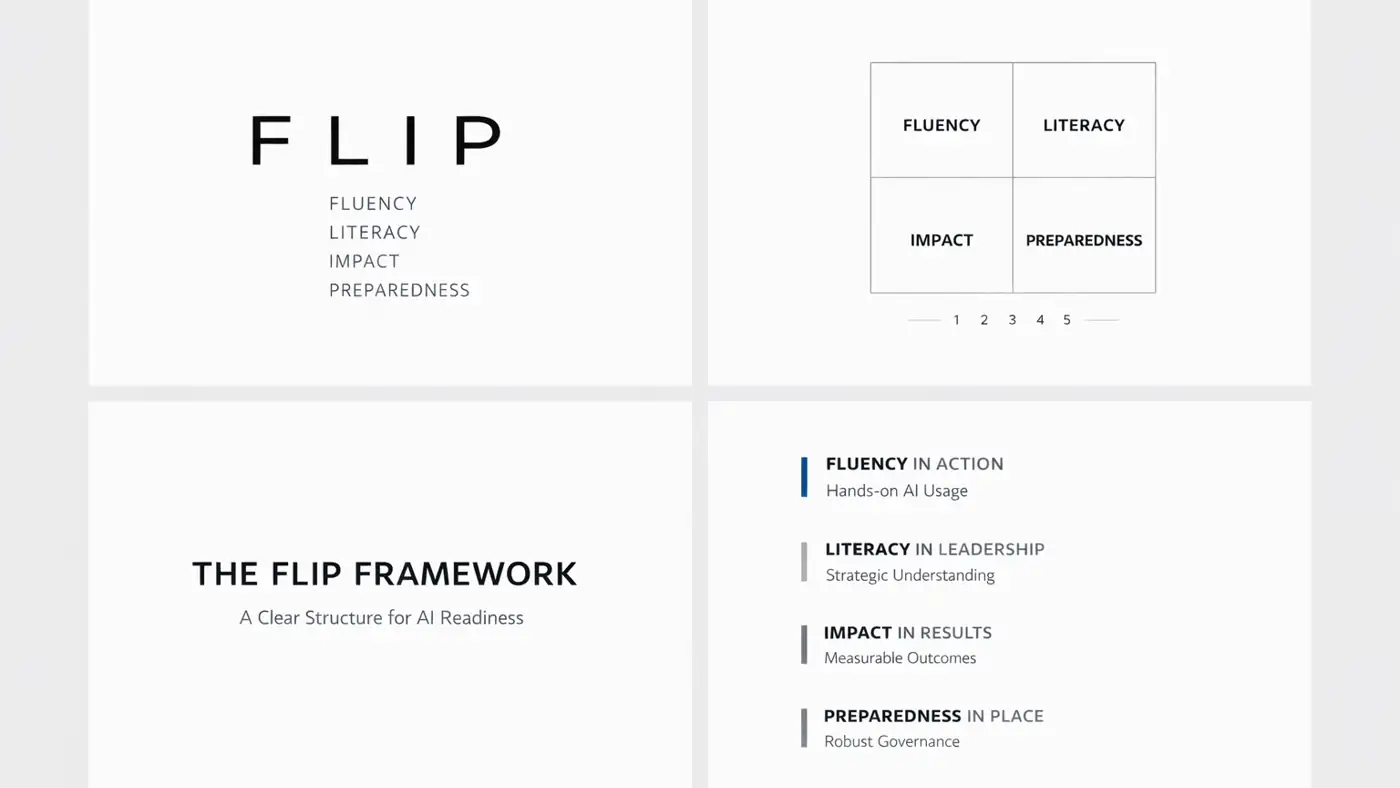
It scores four things: Fluency, Literacy, Impact and Preparedness. Twenty minutes. One honest score. One gap to fix first.
Key points
I’m ZAK, founder of ORKA AI in Calgary. My work is sitting with Canadian owners and leadership teams who want AI to do something useful after the demo ends. I write about that work on aiwithzak.com.
Here’s the pattern that kept coming up in my work. A team buys licences. A few keen people start using them. Six months later, nobody can say if it worked, who’s in charge or what data went where. So I wrote down the four questions I kept asking in every room. That list became FLIP.
What is the FLIP AI readiness framework?
FLIP is an AI readiness framework that scores a team on four pillars: Fluency, Literacy, Impact and Preparedness. Each pillar asks one plain question about people or operations, and each gets a score out of 25. Your total shows your stage. Your lowest pillar shows the next move.
The four questions are simple on purpose:
- Fluency: can your people use AI tools to do real work?
- Literacy: do they understand AI well enough to use it wisely and safely?
- Impact: is AI changing results you can point to?
- Preparedness: is the business set up to grow AI without chaos?
Two pillars are about people. Two are about the business. You need all four, and you rarely have all four at once.
Why do Canadian teams need an AI readiness framework now?
Because adoption is moving faster than understanding. Statistics Canada reported that 12.2% of businesses used AI to make goods or deliver services in the year before its spring 2025 survey, double the 6.1% from a year earlier. Use is spreading. The habits, rules and measures around it are lagging.
That number comes from Statistics Canada’s June 2025 analysis of AI use by businesses. Doubling in a year sounds great. It also means a lot of teams are adopting tools before anyone has decided how they should be used.
That gap shows up across sectors. Lots of businesses still sit on the sidelines, a theme we covered in why many smaller Canadian firms still hold off on AI. The ones that jumped in often skipped the boring parts. FLIP is built to catch both groups.
How do you score your team with FLIP?
Each pillar has five statements. Rate each one from 1 to 5, where 1 means not true for your team and 5 means true and consistent. Add each pillar out of 25, then the total out of 100. Score alone first, then compare with your leadership team.
One rule makes it work. Score what is true today. A tool you bought and nobody opens is a 1. A pilot you plan for next quarter is a 1. Honest scores are the whole point.
What does a lopsided FLIP score tell you?
A lopsided score tells you where the risk lives. High Fluency with low Literacy means people move fast and paste the wrong things into the wrong tools. High Impact with low Preparedness means early wins that spread faster than your rules. The lowest pillar is your next 30 days.
My favourite part of FLIP is the disagreement. Say, as a made-up example, your finance lead scores Impact at 8 and your operations lead scores it at 20. You have found something more useful than any average. Talk about that gap first.
Want a practical starting point for Fluency? Our piece on measuring the hour a day practical AI can save is a good warm-up.
What should you do after the FLIP score?
Pick one pillar, one owner and one date. Do not try to fix all four. Choose the lowest pillar, agree on one small action, and give it 30 days. Then rescore that pillar and share the result at your next leadership meeting.
Here’s how I’d start this week:
- Print it. Download the free FLIP scorecard and print one per leader.
- Score alone. Book 20 minutes. Everyone scores in silence.
- Go public. Put the four pillar scores side by side on a whiteboard.
- Circle two things. The lowest pillar and the widest disagreement.
- Commit. Name one owner and one date. That’s it.
Over the coming months I’ll go deeper on each pillar, one at a time. Start with your score. Everything else gets easier once you know where you actually stand.
How is FLIP different from other AI readiness frameworks?
Most AI readiness frameworks start with data pipelines, cloud setup and model choice. Those matter, but they assume a technical team. FLIP starts with the people who run the business. Any owner, finance lead or operations lead can score it in one sitting, with no consultant in the room.
I also kept it short on purpose. Twenty statements, one page per pillar. An AI readiness framework that takes a month to complete tells you where you were last month. FLIP is meant to be rescored every quarter, because the tools keep changing and your habits need to keep up.
One honest limit: FLIP won’t pick your tools or fix messy data for you. It tells you where people and operations are weak, so the money you spend next goes to the right pillar.
Frequently asked questions
What does FLIP stand for?
FLIP stands for Fluency, Literacy, Impact and Preparedness. It is an AI readiness framework created by ZAK in Calgary in November 2025 for Canadian business leaders.
How long does the FLIP scorecard take?
About 15 to 20 minutes per person. Each leader rates 20 statements from 1 to 5, five per pillar, then the team compares scores.
Is FLIP a technical assessment?
No. FLIP looks at people and operations: skill, judgment, results and guardrails. You do not need a technical background to use it.
Where can I get the FLIP scorecard?
The free FLIP scorecard is available at aiwithzak.com/flip-framework.
Disclosure: ZAK is the founder of ORKA AI; aiwithzak.com is his website. This column describes his own framework. It is analysis and opinion.