





Businesses keep asking which AI model is best. I think the better starting point is much closer to home: what work do you actually need AI to do?
If I were choosing an AI platform for a 50-person company today, I would not start by asking which model is smartest.
I would ask what the company wants the thing to do on Monday morning.
That is why I think the ChatGPT vs Claude vs Gemini debate starts one decision too late. Comparing the models is useful. Building your AI strategy around whichever one appears to be winning this month is much less useful.
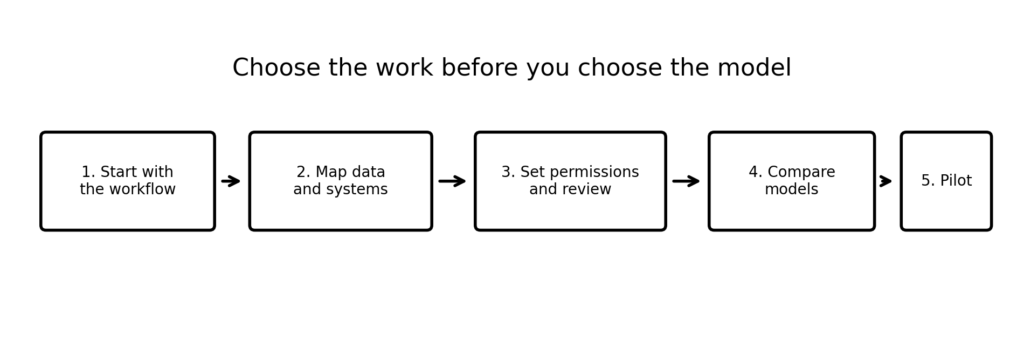
For a business, the best AI is the one that fits the work. Start with the workflow, the information it requires, the systems involved, the people responsible for the result and the level of human review. Then decide which model earns a place inside that process.
That may sound less exciting than comparing benchmarks. It is also much closer to the decision an actual business has to make.
The products are moving faster than your workflow
Look at what has happened this month alone.
OpenAI added a Data capability that can work with connected company information inside ChatGPT Work, followed by ChatGPT for Word for Business customers.
Google expanded Gemini in Workspace so it can connect with business tools including Salesforce, QuickBooks, HubSpot, Asana and Monday, then announced another wave of connected apps for Gemini on September 23.
Anthropic introduced Claude Opus 5.5 on September 22 and says it performs around the level of its previous Fable 5.1 model on most work while costing 40% less to run than Opus 5.
Three companies. A couple of weeks. Different models, integrations, costs and ways of working.
A comparison made today can look different surprisingly quickly.
The workflow inside your company probably does not move at that speed.
Your sales team will still need to prepare for calls. Someone will still have to answer customer emails. Operations will still need information from the field. Finance will still need reports. Managers will still have to review work that matters.
That is where I would anchor the decision.
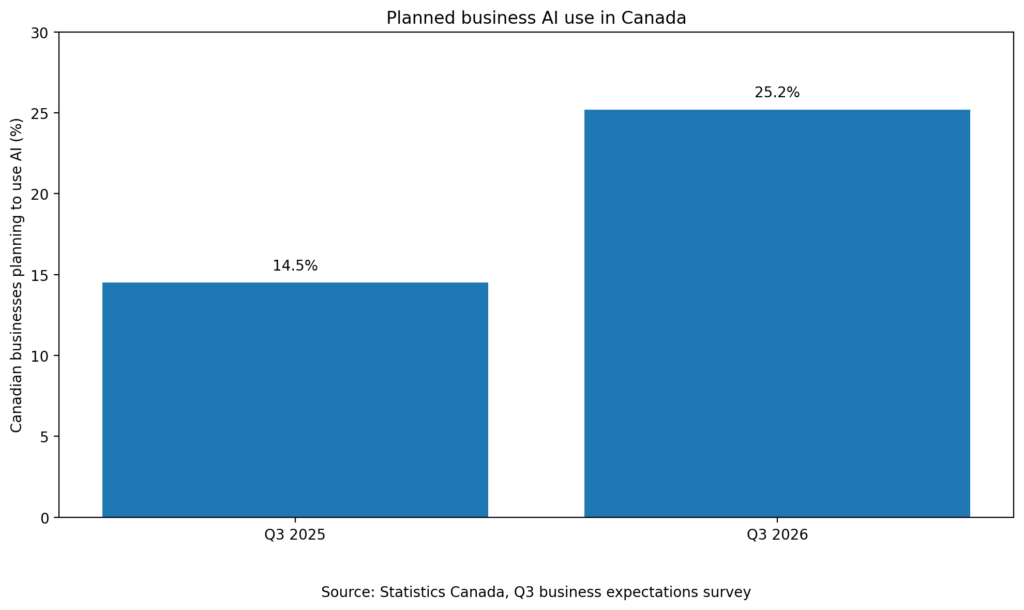
Canada is still early enough in business AI adoption that this matters. Statistics Canada reported that 25.2% of Canadian businesses planned to use AI over the following 12 months in the third quarter of 2026, up from 14.5% one year earlier.
A lot of companies are going to make their first serious AI platform decisions over the next year.
I would rather see them choose based on their work than on a leaderboard.
Start inside the business
Imagine the company wants AI to help with customer follow-up.
You can put the same prompt into ChatGPT, Claude and Gemini. Compare the emails. Decide which one writes the nicest response.
Useful test.
It still tells you very little about how well AI fits into the business.
Where does the customer information live?
Does someone have to copy it into the AI every time?
Can the AI access the approved information directly?
Who decides when the customer should be contacted?
Does a person review the response before it goes out?
Does the result need to be recorded in the CRM?
What happens when the customer’s email conflicts with what the CRM says?
Those questions make the model comparison more useful because now there is a job attached to it.
You are no longer asking which AI writes the best email. You are asking which setup improves the whole customer follow-up process.
That difference matters.
A model can produce an excellent answer and still create a poor business workflow.
If an employee has to find the information in three systems, paste it into an AI tool, correct the result, copy it somewhere else and then update the CRM manually, I am not particularly interested in how impressive the first draft looked.
I want to know if the work got better.
The software around the model matters
This is one reason I think generic rankings of the “best AI for business” can only take a company so far.
The company already has an operating environment.
Maybe most of its files, calendars and communication sit inside Microsoft 365.
Maybe the organization runs heavily on Google Workspace.
Maybe its important work happens inside Salesforce, HubSpot, QuickBooks, a construction platform, an industry-specific application or a collection of systems that do not talk particularly well to each other.
That changes the answer.
Where the information lives matters.
Permissions matter.
Administrative controls matter.
The amount of manual work required to give AI the right context matters.
The ability to connect the output back into the business matters.
For teams already comparing platforms at that level, I have a separate practical guide on choosing between Copilot, ChatGPT and Claude for an Alberta team. The conclusion there is deliberately practical: the place your information already lives can matter more than small differences in subscription price.
That does not mean companies should automatically buy whatever AI product comes bundled with their existing software.
It means integration belongs in the decision.
So does administration. So does privacy. So does the actual experience of the people who will have to use it every week.
Buying all of them does not solve the problem
There is another response to the ChatGPT vs Claude vs Gemini question that sounds attractive.
Do not choose. Give everyone everything.
For some teams, access to multiple models makes sense. Different tools can genuinely be better suited to different kinds of work.
But I would not confuse optionality with strategy.
I have already written about AI tool sprawl becoming an operating problem for Canadian businesses. The underlying issue is not the number of subscriptions. It is what happens when nobody knows which tool belongs in which workflow, who owns it, what information it can touch or what result it is supposed to improve.
Giving a team three general-purpose AI platforms can create the same problem.
One employee develops a process in ChatGPT. Another does similar work in Claude. A third builds something in Gemini. Six months later the company has useful experiments everywhere and very little shared operating knowledge.
The business has learned how three individuals use AI.
It has not necessarily learned how the business uses AI.
I would rather standardize where it makes sense and make exceptions where the work earns them.
I would assume the winner can change
I would also make one uncomfortable assumption when choosing an AI platform.
The company may want to change later.
That should affect the way the workflow is designed now.
If all of your instructions, processes, company knowledge and operating logic become inseparable from one vendor, changing models becomes a business project instead of a software decision.
That may sometimes be worth it. Deep integration can create enormous value.
It should still be a conscious choice.
I would want the durable part of the system to be the work itself.
What information is required?
What should happen first?
What does good output look like?
Where does human judgment stay?
What system owns the final record?
What happens when the AI cannot complete the task?
Those questions survive a model change.
A benchmark does not.
Five questions before you choose
So if someone asked me today, “Should our company use ChatGPT, Claude or Gemini?”, I would not dodge the comparison.
I would make them answer five questions first.
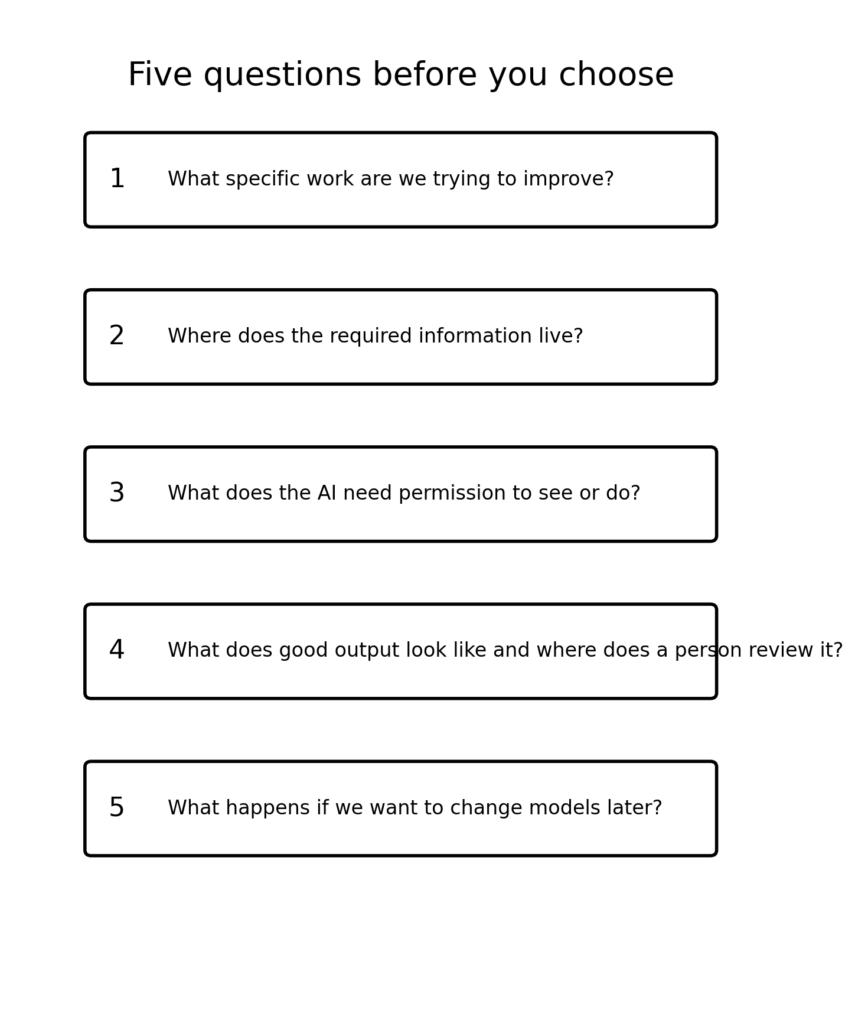
Then I would test the serious candidates on the same representative piece of work using information the business is permitted to use.
Do not compare only the answer.
Compare how much time it took to provide context. Look at the corrections required. Look at the steps before and after the AI. Look at administration, permissions and how the result gets back into the system where the work actually lives.
That is a much better business test than asking three chatbots the same clever question.
ChatGPT, Claude and Gemini will all keep changing.
A company does not need to predict which AI company eventually wins. It needs to understand its own work well enough to recognize which technology deserves a place in it.
A practical next step
If your team is discussing AI tools but does not yet have a shared plan for where AI belongs, I built a free AI Roadmap for Business to help work through the business outcome, workflow, readiness, human review, ownership and first 90 days.
About ZAK
ZAK is a Calgary-based AI strategist helping Canadian business leaders turn AI confusion into practical automation, agents, governance and measurable business systems. He writes about practical AI strategy, implementation and leadership at AIwithZAK.com