





How distributed computing could turn Canada’s energy province into an AI powerhouse
I have been watching this unfold for over a year and the pattern is unmistakable. Every week another announcement lands. Microsoft secures long-term power in Alberta.
Amazon confirms plans for new facilities near Calgary. Another global firm quietly scouts Edmonton.
Most people see separate events.
The real story sits beneath the surface. Alberta is building what no other region in North America can match at this scale, a distributed network of AI infrastructure that turns our energy strength into long-term digital advantage.
I believe that this is truly the next phase of Alberta’s innovation economy.
The numbers behind the shift
Alberta’s government now treats AI infrastructure as a strategic industry. The provincial Data Centre Concierge Program targets $100 billion in private investment, backed by policy that makes large-scale development possible.
In 2025 alone, more than 18 000 megawatts of new data-centre projects applied for grid connections through the Alberta Electric System Operator. That represents the equivalent power use of 18 million homes.
The largest data centre in Canada is already rising north of Calgary with 90 megawatts of capacity, purpose-built for AI workloads. AESO has since introduced a temporary 1 200 megawatt cap to pace new connections, not to slow growth but to manage how fast demand is arriving.
When the regulator steps in to phase growth, you know the opportunity is real.

Energy abundance becomes strategic
AI infrastructure consumes huge amounts of electricity. The global race for compute power is becoming a race for available energy. In this race, Alberta holds the advantage.
The province produces large volumes of natural gas and renewable energy, with some of the lowest industrial power costs in North America. Even better, it already wastes more energy than many regions can generate. Flaring, idle industrial sites, and underused grid capacity all represent untapped potential for AI energy solutions in Canada.
The government’s framework allows behind-the-fence generation so data centres can build or partner directly at source. Every flared kilowatt becomes computation. Every idle facility can host a micro data centre. This is waste energy computing turned into value.
Climate as an economic advantage
Cooling is a constant drain on data-centre budgets worldwide, but not in Alberta. The cold, dry climate offers natural efficiency for most of the year.
Free-air cooling reduces operational costs by up to 40 percent compared with warmer markets. Over time that is a structural advantage few regions can match. It makes Alberta one of the most cost-efficient places for distributed data centres in Canada.
The modular build-out
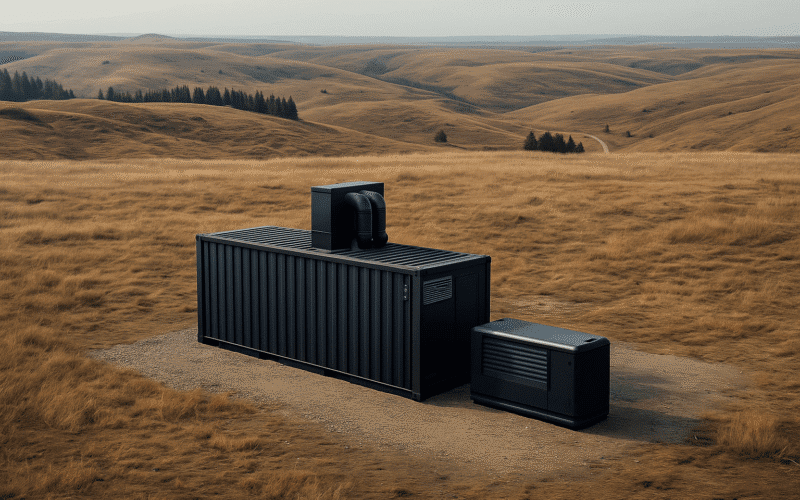
The biggest technical shift enabling this growth is modular design. Modern containerized micro data centres pack hundreds of kilowatts of compute into 20- or 40-foot units.
They deploy in weeks, not years.
Capital costs are a fraction of traditional builds, around two to four million dollars per megawatt instead of ten to fifteen. That speed and flexibility align perfectly with Alberta’s distributed geography and grid management.
Instead of one hyperscale complex, Alberta can host hundreds of modular sites across the province. Each community gains local compute, jobs, and tax revenue while contributing to a wider Alberta digital infrastructure network.
What Alberta could look like by 2027 and beyond
By 2027 Alberta’s distributed network of modular data centres will already be in full expansion. Pilot sites will be running, energy partnerships established, and smaller municipalities connected through edge computing infrastructure.
Industrial sites could integrate compute directly into operations. Oil and gas facilities use flared gas for power. Manufacturing plants run AI inference at night. Agriculture processors near Lethbridge turn off-season capacity into year-round income.
By 2028, the province could operate 60 to 80 micro data centres across communities like Okotoks, Strathmore, Cochrane, and Lethbridge. Each site might run 400 to 1 600 kilowatts of capacity, enough to support local businesses, hospitals, and public services.
At the top of this network, major data-centre anchors in Calgary and Edmonton manage large-scale AI training workloads. Together they form a connected system of edge computing across the province, a living example of modular data centres in Alberta powering a provincial AI sovereignty model.
Why sovereignty matters
AI sovereignty has become a national conversation, but its real foundation is local control. When Alberta businesses run workloads through data centres in Oregon or Toronto, they lose authority over where their information lives.
Keeping processing within Alberta’s borders keeps data, jobs, and tax revenue here. Energy, healthcare, and agriculture all depend on this control. True Alberta AI infrastructure means computation powered by Alberta energy and governed by Alberta policy.
Distributed resilience
Distributed networks are naturally resilient. If one node requires maintenance, another takes over. If power drops in one region, others keep running. Severe weather or grid events cause local issues, not provincial outages.
This reliability makes distributed architecture vital for hospitals, finance, and logistics. Edge computing in Alberta gives companies a dependable base for mission-critical operations while reducing reliance on outside providers.
The challenges ahead
There are still hurdles. AESO’s 1 200 megawatt limit reflects real grid pressure. Workforce training must accelerate to prepare hundreds of technicians and operators. Policy alignment across municipalities and industry partners remains complex.
Yet these are solvable problems. Colleges can expand technical programs. Energy firms can co-locate data-centre projects. The Concierge Program provides coordination. Alberta’s track record shows that when regulation and entrepreneurship align, industries scale fast.
The turning point
Between 2026 and 2027 Alberta’s distributed data-centre network will move from pilot to expansion. By 2028 it will operate as a connected provincial system.
By that stage Alberta will not be pitching potential. It will be delivering compute capacity, jobs, and digital sovereignty across the province.
The choice ahead
Alberta has everything required to lead North America’s distributed AI infrastructure movement. Energy abundance, climate advantage, modular technology, and a government actively courting investment.
The only variable is execution. The policy is written, the technology is mature, and the demand is undeniable.
If stakeholders align, Alberta can define what a modern innovation economy looks like, one built on data, power, and local control.
The pieces are in place.
The opportunity is immediate. The next few years decide how far Alberta’s AI infrastructure can go.
Opinion Column by Zak Hussein, CEO at ORKA AI and Founder of AIwithZAK.com