

Somebody has to look after an AI agent once it ships. AI agent maintenance means testing it, updating it, watching its costs and eventually shutting it down, and most Canadian organizations haven’t hired for that work yet.
- AI agent maintenance is the ongoing work of testing, updating, securing and retiring agents after launch.
- Agents end up siloed across tools and teams, the models under them retire on vendor schedules, and token bills climb when nobody watches them.
- Statistics Canada says 19.2% of businesses used AI in the past year, triple the 2024 rate. Deloitte found only 21% of firms have mature governance for agents.
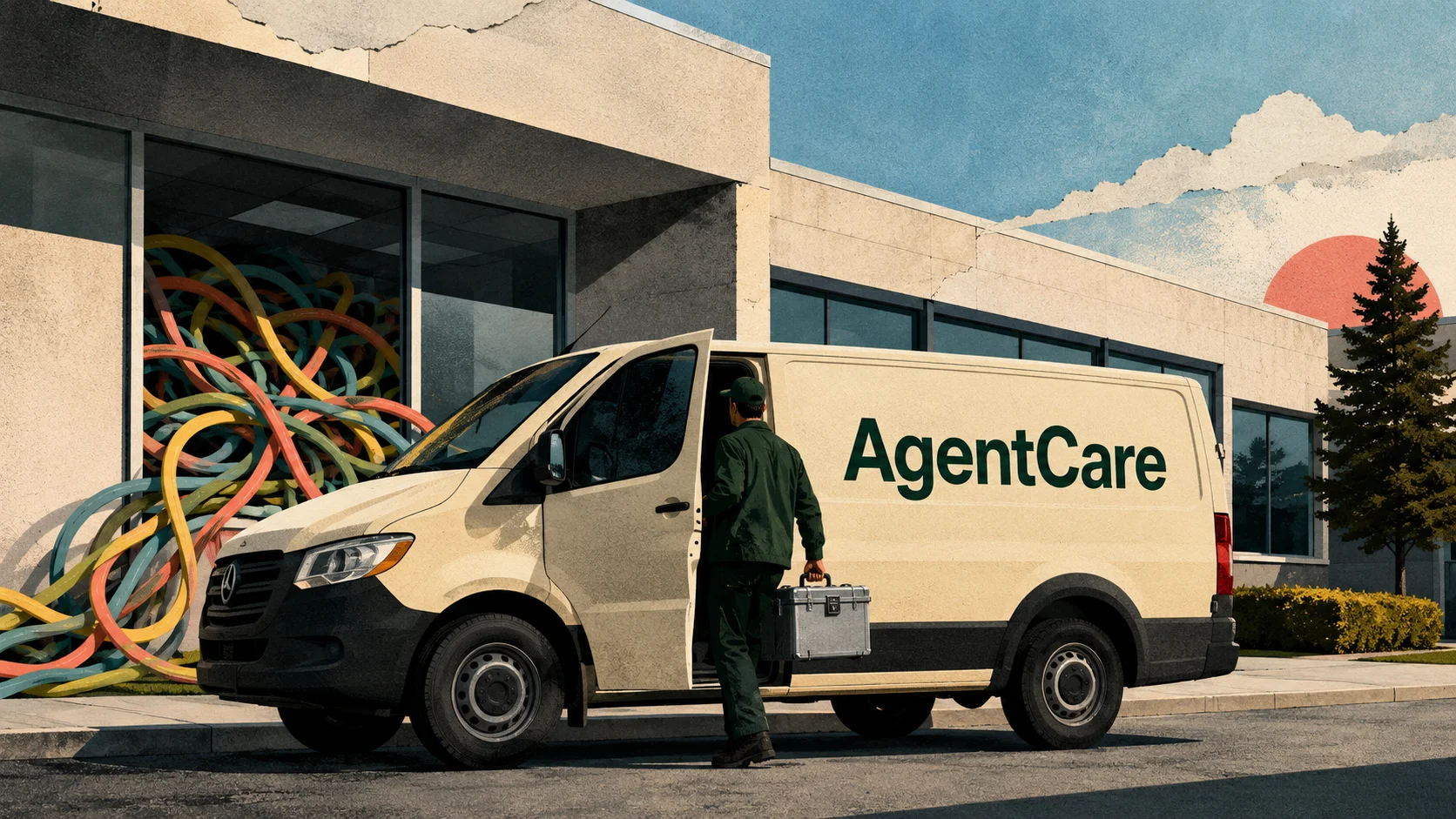
- My view: agent maintenance and stewardship will become an industry of its own. I call it AgentCare.
I’m ZAK, founder of ORKA AI in Calgary. My work is helping Canadian organizations put AI to work and keep it working, and I write about it on my website, aiwithzak.com. Across that work, I keep seeing the same gap. Companies pay to build agents. Almost nobody pays to look after them.
Canada’s cyber agency co-signed guidance this year telling organizations to keep “ongoing visibility and assurance” over their AI agents. That describes a job. I think it becomes a whole service category, the way IT support did 30 years ago.
What is AI agent maintenance?
AI agent maintenance means looking after every part an agent depends on: the vendor’s model, prompts, company data, software connections, staff permissions, approval rules and the bill. Any one can change without warning while the agent keeps running. A broken furnace tells you it’s broken. A neglected agent keeps giving confident answers from an old price list.
Why do AI agents and workflows become siloed?
Because they’re built one at a time, by different people, in different tools. Sales builds a lead agent in one platform. Operations wires up a reporting workflow in another. Someone in finance connects a chatbot to the shared drive. Each works. None of them know about the others, and nobody holds the full list.
That’s the next version of shadow IT, and the numbers say it’s coming fast. McKinsey’s November 2025 survey found 62% of organizations at least experimenting with agents. Deloitte’s 2026 survey found 74% expect to use agents at least moderately by 2027, but only 21% have mature governance, meaning clear limits on what agents decide alone, monitoring and audit trails. We’ve covered how shadow AI is already spreading in Canadian workplaces. Agents make it worse, because they act.
Why do AI models change and retire?
Vendors retire models on a schedule, and they say so in writing. Anthropic’s deprecation page says it “regularly retires older” models and gives “at least 60 days’ notice” for publicly released ones. Amazon Bedrock moves models from Active to Legacy to end-of-life and tells customers to migrate before the date. Google Cloud lists a retirement date beside each Gemini model.
Sixty days is plenty if you know which agents use which model. Most companies don’t. A replacement can format answers differently, read instructions differently or call tools in another order, so changing the model name in a settings screen is not a migration. Someone has to rerun real business cases and sign off. Our guide to owning your own AI model evaluation shows how.
How do token costs burn through AI budgets?
Agents are billed by the token, and they loop, call tools and reread context, so they use far more than a person typing into a chat box. Anthropic’s pricing page lists Claude Opus 5.5 at US$4 per million input tokens and US$20 per million output tokens, so output costs five times as much.
The same page notes that tool definitions and tool results add tokens to every request.
None of that shows up in a demo. It shows up three months later, when an agent on a premium model is doing work a cheaper model or a plain rule could handle, and two departments are paying for agents that do the same job. Our piece on setting an AI agent token budget shows how to put a number on it.
| Figure | What it shows |
|---|---|
| 19.2% | of Canadian businesses used AI to produce goods or deliver services, up from 6.1% in 2024 |
| 13.7% | of those AI users run AI decision systems, up from 5.7% a year earlier |
| 21% | of firms worldwide report a mature governance model for AI agents |
Sources: Statistics Canada, Canadian Survey on Business Conditions, second quarter of 2026 (collected April 1 to May 6, 2026); Deloitte, State of AI in the Enterprise 2026 (3,235 leaders, 24 countries).
What do Canadian regulators expect?
No Canadian law tells you to maintain your agents, but two federal bodies come close. The Canadian Centre for Cyber Security and the Privacy Commissioner both expect clear ownership, limited access, a way to switch automated actions off, and accuracy for as long as a tool is in use, with the organization accountable.
The Canadian Centre for Cyber Security’s agentic AI guidance says never grant agents “broad or unrestricted access.” Its frontier AI note asks firms to assign clear ownership and keep the ability to disable automated actions. The Privacy Commissioner’s generative AI principles say tools “must be accurate throughout the intended lifecycle” and that accountability “rests with the organization, and not with any kind of automated system.” If the agent gets it wrong, you own the mistake. You can’t own something nobody is watching.
How do you keep the people who build your agents for the long term?
This is the question I push hardest with the organizations I work with. The person who built an agent knows why it works. When they leave, or the contractor’s project ends, that knowledge walks out with them. Here’s what I tell Canadian organizations and small businesses:
- Hire for the relationship, not the launch. Ask any builder or consultant who looks after the agent in month six and year two, and get it in writing.
- Pay for upkeep as a line item. A small monthly retainer for testing and updates is cheaper than a rebuild after a model retires.
- Make the knowledge transferable. Every agent gets a written service record, so a new person can pick it up in a day.
- Keep two people on every agent. One builds, one shadows. In a 10-person firm, that second person can be the owner.
- Keep agents portable. Avoid setups only the original vendor can repair, so a price change or retirement notice doesn’t trap you.
What would an AgentCare service do?
An AgentCare service would look after AI agents the way a good mechanic looks after a fleet. It keeps a record of every agent, watches vendor model retirement dates, reruns real test cases after any change, refreshes the facts agents rely on, and reviews access and costs every quarter. The checklist below shows where to start.

The AgentCare checklist. Start with the agents that touch customers or money.
- Record it. Purpose, owner, builder, model, data, tools and monthly cost.
- Watch the model calendar. Track retirement notices and list every agent each one affects.
- Keep a test set. Ten to twenty real cases the agent must pass after any change.
- Refresh its knowledge. Current policies, prices and product facts only.
- Review access every quarter. Remove access the day someone changes roles or leaves.
- Test the human checkpoints. Refunds, customer messages, purchases and deletions still need a person.
- Check the bill monthly. Cut duplicates and move simple tasks to cheaper models.
- Name an incident owner. Start with our AI agent incident plan.
- Retire on purpose. Revoke credentials, keep required records and cancel subscriptions.
Will agent maintenance become its own industry?
I believe it will. Platforms will add monitoring, and our coverage of AI agent controls shows the tooling is improving, but a vendor only sees inside its own platform. It doesn’t know your sales agent quotes last quarter’s prices, or that two teams built the same agent. Monitoring says a task finished. Stewardship says it was the right task, done well, at a sensible cost.
What would change my mind: if the big platforms ship cross-vendor inventory, automatic regression tests on model swaps and permission reviews as standard features by the end of 2027. I don’t see that yet. Someone has to look after the agents, and I expect that to be a profession.
FAQ
What is AI agent maintenance?
AI agent maintenance is the ongoing work of testing, updating, securing and retiring AI agents after they go live. It covers model changes, data updates, permission reviews, cost checks and human approval steps.
What happens when an AI model an agent uses is retired?
Requests to a retired model fail, so the agent stops working until someone moves it to a new model. Anthropic gives at least 60 days’ notice for publicly released models, and the new model should be tested on real cases before launch.
Why do AI agent token costs grow over time?
Agents loop, call tools and reread context, and output tokens often cost several times more than input tokens. Costs climb when agents run on premium models for simple tasks or when teams build duplicate agents.
Who is accountable when an AI agent makes a mistake in Canada?
The organization is. The Privacy Commissioner’s generative AI principles say accountability for decisions rests with the organization, not with any automated system.
Last fact-checked October 28, 2026.
Disclosure: ZAK is the founder of ORKA AI; aiwithzak.com is his website. This column mentions his own projects. It is analysis and opinion.